
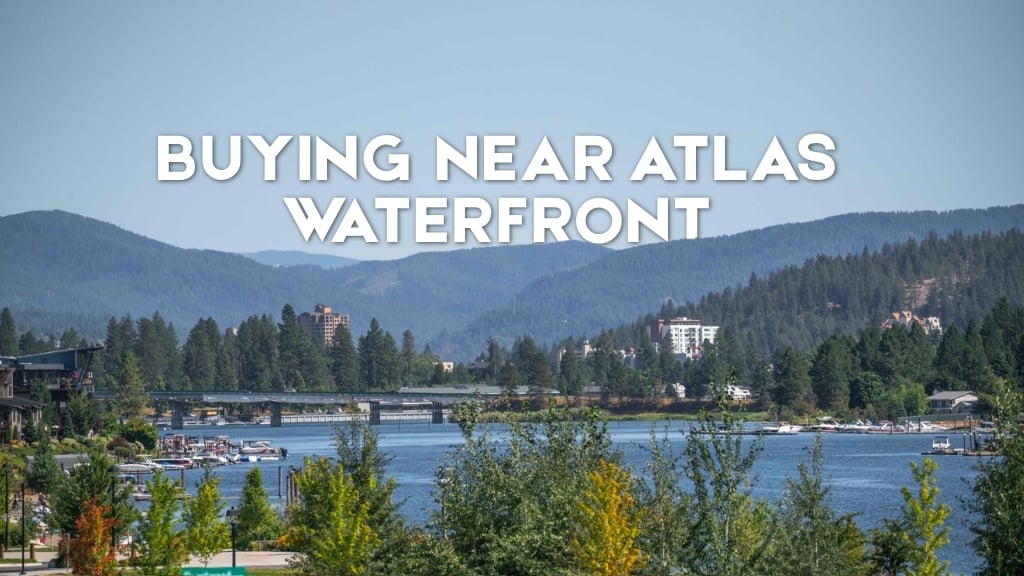
Atlas Waterfront has the kind of setting that can make a buyer picture the lifestyle almost immediately: river access, trails, newer homes, open space, and a location that still feels connected to the rest of Coeur d'Alene. Then comes the harder question.
What happens when the neighborhood you love today is still changing around you?
That is the real challenge with buying at Atlas Waterfront right now. Some of the neighborhood is already real and usable. Other pieces are governed by approved development standards but have not yet been built, and some future parcels are still moving through developer selection and design stages.
For buyers, the goal is not to predict exactly what Atlas will look like in ten years. It is to understand what is known, what is still flexible, and what questions deserve attention before you buy. The broader Atlas Waterfront project covers roughly 70 acres and includes about 24.5 acres of public open space along approximately 3,780 linear feet of Spokane River shoreline.
The City of Coeur d'Alene approved the Planned Unit Development and preliminary plat in 2019, and the neighborhood continues to develop in phases under updated development standards and architectural guidelines.
The First Rule: Separate What Exists From What Is Still on Paper
This sounds simple, but it is probably the most important habit a buyer can have in any new development in Coeur d'Alene. A rendering may look finished. A site plan may show buildings, landscaping, retail, and pedestrian connections in impressive detail. That does not necessarily mean every piece shown will be built exactly as illustrated.
At Atlas Waterfront, buyers should mentally divide the neighborhood into three buckets: what already exists, what is approved or governed by existing standards, and what remains proposed or dependent on future development decisions.
Start With the Things You Can Actually Experience Today
The public waterfront component is not just a future promise. The Atlas project was designed around permanent public river access, and substantial public open space is already part of the neighborhood framework. The City's project materials identify approximately 24.5 acres of public open space and nearly 3,800 linear feet of public shoreline within the overall Atlas Waterfront plan.
That distinction matters because existing amenities can be evaluated today. You can walk the area, experience the street layout, see how far a property feels from the river, and decide whether the current neighborhood already works for you. That is a very different question from buying because you expect a future restaurant, retail area, or unobstructed view that does not yet exist.
Then Look at the Rules Guiding What Comes Next
Atlas Waterfront is not developing without a framework. The neighborhood has detailed development standards and architectural design guidelines that establish expectations for building placement, street frontage, landscaping, pedestrian connections, housing design, parking, and other features.
The Architectural Design Guidelines go even further into the desired character of the neighborhood, including residential building forms, porches and stoops, street orientation, roof forms, materials, fencing, landscaping, and the relationship between homes and public spaces.
That does not tell you exactly what every future building will look like, but it gives you something much more useful than guessing: a documented framework for how the neighborhood is intended to evolve.
Look Beyond the Home and Study the Parcels Around It
A beautiful house can feel very different five years later if the empty parcel across the street becomes something you were not expecting. That does not mean future development is a problem. It simply means unfinished land deserves just as much attention as the house itself.
Ask What Is Allowed on Nearby Sites
The Atlas master-planning framework accommodates a mix of residential and commercial uses. Depending on the development area, future parcels may support single-family homes, townhomes, multifamily residences, condominiums, or commercial uses.
That mix is part of what could eventually make Atlas feel like a fuller neighborhood rather than a conventional subdivision, but it also means buyers should not assume the current surroundings will stay exactly as they are.
The Development Standards include different frontage and building requirements for residential, multifamily, retail, and mixed-use settings, including expectations for pedestrian-oriented streets, building entrances, sidewalks, landscaping, and commercial frontage.
As real estate professionals helping buyers and relocation clients throughout Coeur d'Alene and the greater Inland Northwest, we have seen how often buyers focus on the view from the living room but forget to ask what the vacant parcel inside that view is actually entitled to become.
Pay Special Attention to Active Development Areas
Area 5A is a good current example. Ignite CDA's 2026 Request for Proposals identifies Area 5A as a roughly 1.3-acre site intended for a higher-density, mixed-use concept. The RFP prioritizes proposals that could include multifamily housing or condominiums with active ground-floor retail or similar uses at a key corner of the site. The important word here is could.
The RFP includes illustrative concepts and development parameters, but those are not the same as a completed project. Buyers should treat them as evidence of the type of environment being considered, not a promise that a particular building, restaurant, shop, or residential count is guaranteed.
The View You Buy Today May Not Be the View You Have Forever
This may be one of the most practical questions in buying in a developing neighborhood. An unfinished parcel can create a beautiful open sightline today. That open space may simply be land waiting for its next phase.
Before placing a premium on a particular view, buyers should review the plat, development-area maps, setbacks, height limits, and allowed building forms around the property. The Atlas development documents establish specific standards for building heights, setbacks, frontage conditions, pedestrian connections, and development-area layouts.
In some areas, buildings are intentionally designed to create a stronger street edge and a more urban pedestrian environment. That does not mean your view will disappear. It means buyers should understand what can legally and realistically happen nearby before paying extra for today's openness.
Construction Is Temporary, but It Still Affects Daily Life
Future development is not only about the finished product. There is also the period in between. Buying while parts of Atlas are still under construction may mean living near grading, building activity, contractor traffic, road work, temporary closures, or unfinished streetscapes for stretches of time.
For some buyers, that is a reasonable trade-off for getting into a neighborhood earlier. Others may decide they would rather wait until more of the surrounding blocks are complete.
Neither choice is wrong. The real question is how much uncertainty and construction activity you are comfortable living with.
We've helped hundreds of buyers and sellers throughout the region, and this is where a neighborhood visit at different times of day can be surprisingly valuable. A site that feels calm on a Sunday afternoon can feel very different during weekday construction hours.
Future Retail Sounds Great, but Don't Buy Based on a Coffee Shop That Doesn't Exist Yet
One of the more appealing pieces of Atlas Waterfront's long-term vision is the potential for mixed-use development. Current Area 5A materials specifically contemplate active ground-floor uses such as retail, and the Development Standards encourage pedestrian-oriented commercial frontages in appropriate areas.
That could eventually mean more opportunities to walk to food, services, shops, or other neighborhood destinations. But buyers should be careful about converting "retail is allowed" into "my favorite kind of retail will definitely open here."
A smarter way to evaluate it is to ask whether you would still be happy with the property if the commercial component takes longer than expected, changes form, or ends up housing uses different from what you imagined. That is a much more durable buying decision.
Traffic and Walkability Can Change as a Neighborhood Fills In
A developing neighborhood rarely moves in only one direction. More homes may mean more cars. More retail can bring additional visitors. At the same time, greater density and mixed-use development may also support a more active pedestrian environment.
Atlas Waterfront's planning standards place noticeable emphasis on pedestrian-oriented streets, sidewalks, public spaces, trails, and connections between development areas. The Architectural Design Guidelines also encourage homes and buildings to engage the street through porches, stoops, entries, landscaping, and other design features rather than turning inward behind large parking areas.
For buyers, the question is not simply, "Will there be more traffic?" It is, "What kind of neighborhood experience is this planning framework trying to create, and does that match the way I want to live?"
Buy the Neighborhood You Understand, Not the One You Imagined
Atlas Waterfront is appealing partly because it is still becoming something. That can give buyers access to a newer riverfront neighborhood with public open space, trails, varied housing types, and the possibility of a more mixed-use environment over time.
It also means the view outside your window, nearby construction activity, traffic patterns, and surrounding uses may continue evolving. You do not have to avoid that uncertainty. You just need to investigate it.
Thinking about buying at Atlas Waterfront or comparing homes elsewhere in Coeur d'Alene? Contact Real Estate Done Right. We can help you look beyond the listing photos, review the neighborhood context, understand nearby development, and decide whether a property still makes sense when you consider both what is there today and what could realistically come next.
FAQs
Is Atlas Waterfront already fully built out?
No, while much of Atlas Waterfront is established, additional parcels remain in development, design, or construction stages.
What should I review before buying at Atlas Waterfront?
Buyers should review the current plat, nearby development areas, approved land uses, development standards, design guidelines, active proposals, and public-space plans.
Can future construction affect my view?
Potentially, as future buildings on nearby vacant or unfinished parcels could change existing sightlines depending on their height, location, and design.
Could there eventually be retail inside Atlas Waterfront?
Yes, parts of Atlas Waterfront are planned for commercial and mixed-use development, including the current Area 5A RFP, which could include ground-floor retail.
Does buying before full buildout mean the property will appreciate more?
Not necessarily, as future development can affect properties differently, so buyers should evaluate current value, nearby uses, future possibilities, and long-term fit.
About Real Estate Done Right
Real Estate Done Right serves buyers, sellers, investors, and relocation clients throughout CDA and North Idaho, with a strong focus on helping out-of-state and regional buyers move confidently into the Inland Northwest.
Ranked #14 in Idaho and among the top 0.5% of agents nationwide, the team has sold more than 250 homes, averages 37 transactions per year, and has earned 85+ five-star Google reviews and 70+ five-star Zillow reviews.
Check out this article next